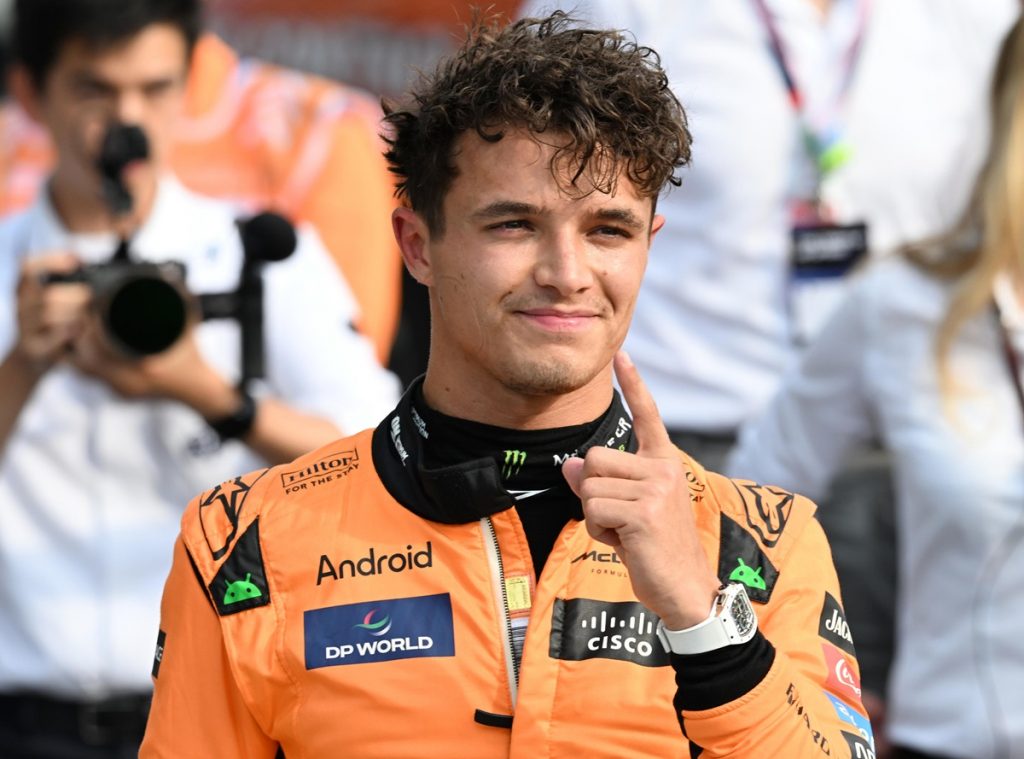
Drivers have largely received the changes as a subtle positive step, with more drastic action required. Scrapping the battery entirely is what Norris is calling for.
Formula 1’s new regulations have proven polarising to say the least. While Lewis Hamilton has spoken positively about these regs, much of the grid has been critical, as has sections of the fanbase.
Over the April break, the FIA announced a series of changes, ones which looked to encourage more flat-out driving in qualifying, and address race safety concerns, a debate accelerated by Oliver Bearman’s 50G shunt at Suzuka.
The FIA clarified that officials have the ability to lower the permitted maximum recharge to 7 MJ per lap at some events, rather than this being a baked-in change across the calendar.
The maximum recharge was unchanged for Miami, however, drivers were limited to 250 kW of energy deployment in sections of the lap, serving as the most notable change for that event.
Miami was classed as an ‘energy rich’ circuit, allowing drivers to push more in qualifying.
Come the race, we saw the frequent position changes typical of F1 2026 competition so far. Charles Leclerc, Norris and Kimi Antonelli battled over the lead, this turning into a two-horse race later in the Grand Prix. Antonelli ultimately took the win – his third on the trot – just over three seconds ahead of Norris.
After the Miami GP, Norris and Antonelli offered their verdict on the FIA tweaks.
Norris did not mince his words.
“It’s a small step in the right direction, but it’s not to the level that Formula 1 should still be at yet,” Norris bluntly declared.
“I think we said yesterday still in qualifying, if you go flat out everywhere and you try pushing like you were in previous years, you still just get penalised for it. You still can’t be flat out everywhere. It’s not about being as early on throttle everywhere.
“You should never get penalised for that kind of thing and you still do.
“So honestly, I don’t really think you can fix that.
“You just have to get rid of the battery. So hopefully in a few years, that’s the case.”
Antonelli added: “Qualifying feels better, more natural.
“Races, the closing speed is massive, and you also need to trust the guy who is defending because also with this active aero, the car is pretty lazy when you want to change direction, so you need to think in advance. And as I said, you need to trust as well, the driver who is defending.
“But it was a small step in the right direction and let’s see what’s going to happen next.”
The FIA has since announced an agreement to tweak the electrical versus internal combustion power ratio of the engines for F1 2027.
FIA president Mohammed Ben Sulayem, meanwhile, has declared that V8 engines will return to the sport, with minimal electric in play.