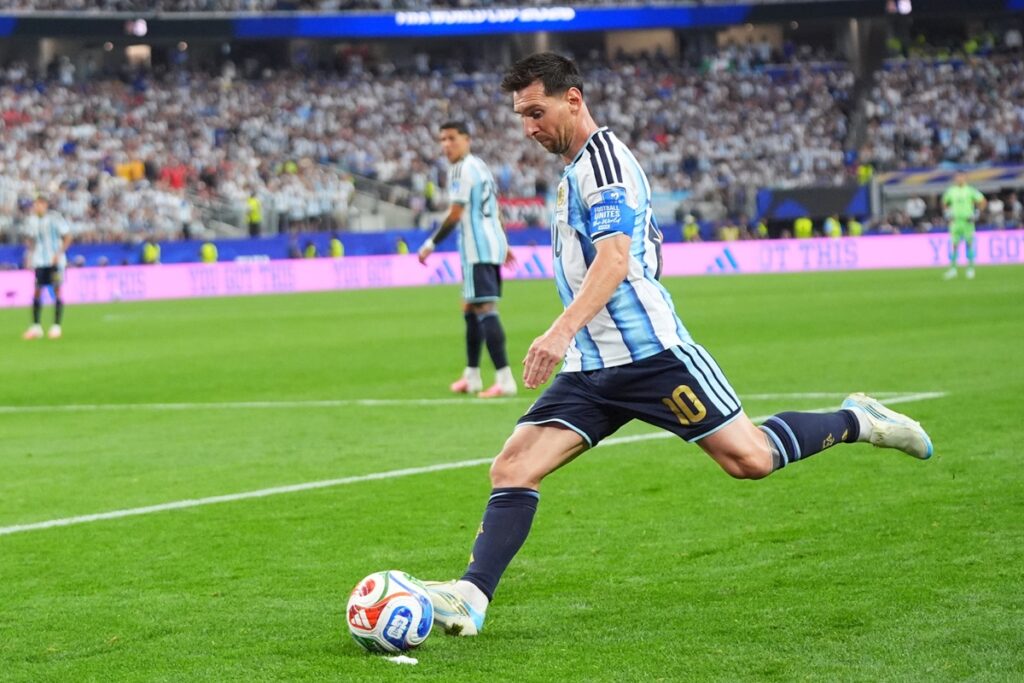
And the marquee names have come to play, with the likes of Messi, Mbappe and Haaland rising to the forefront of the World Cup conversation. Hell, even a 41-year-old Cristiano Ronaldo woke up from hibernation to score a brace (albeit against an abject Uzbekistani side). But are the superstars papering over significant cracks? At the risk of sounding like the curmudgeonly old man from Pixar’s Up, I can’t help but feel a bit underwhelmed by some of FIFA’s new initiatives. They have meddled with a perfect formula, creating a lumbering oaf of a tournament that has been stripped of some of the jeopardy that made it so exhilarating in the past.
Bigger isn’t always better
The decision to expand the competition from 32 to 48 teams (104 matches) has diluted the impact of these early matches. The classical World Cup model featured eight groups of four, with the top two from every group progressing to the round of 16. There are now twelve groups of four, with the top two from each group and the best eight 3rd placed sides making it to a new Round of 32 phase. Sure, this new system is conducive to the type of fairytale narratives that audiences love. But it also means that the top sides can be bang average and still stand a solid chance of qualification. The sense of jeopardy was a cornerstone of what made the Group Stage my personal favourite part of the tournament. Now it feels like a glorified training session, requiring the big teams to just pitch up just once to really cement their place in the next round.
Lack of early heavyweight battles
Also, the fact that the teams are spread out so thin means that we aren’t getting the type of blood-and-thunder Group Stage fixtures that we usually do. So, not only do the games have less jeopardy, but there’s less chance of seeing a Brazil-Portugal clash, etc. Dividing the top nations between twelve groups is diluting the competitiveness of these early groups, nullifying the possibility of a big early exit.
Head-to-head record takes the sting out of matches
And let’s spare a moment for FIFA’s shortsighted decision to trade goal-difference for head-to-head record in the case of a tiebreak. Why? It’s a decision that has rendered many of the upcoming group matches redundant. Take for instance tonight’s clash between Germany and Ecuador. Germany currently sit on six points in the group while Ivory Coast- their closest challengers- are on three points. But because it goes down to head-to-head, Germany will finish on top of the group regardless of the outcome any of the matches (Germany beat Ivory Coast 2-1). So, what’s the incentive for Germany tonight? It winds up working against the African nation, as Nagelsmann might rotate the squad and give Ecuador more of a chance to pull off an upset.
USA vs Tunisia a dead rubber
Tomorrow’s clash between USA and Tunisia is another example of the folly of this new system. The USA sit comfortably atop the group; three points clear of both Australia and Paraguay (Tunisia sit rock-bottom with zero points). But the States have already beaten the two chasing teams, meaning they are already guaranteed a top-spot finish. Likewise, Tunisia lost to both Sweden and Paraguay and can’t progress (even if they beat the host nation 10-0). Using head-to-head record as a tiebreak method just takes the competitive soul out of too many of these matches. That- combined with a more forgiving qualification process- takes the sting out what is usually the most cutthroat part of the entire tournament. 32 of the 48 teams remain after this round of fixtures (two-thirds of the teams compared to half). The group stage is supposed to feel more meaningful than this.
Hydration fiasco
And now for some low-hanging fruit: the hydration breaks. Look, I understand the theory behind the breaks in extreme weather. But why couldn’t we just stick to the guidelines used during the last World Cup in Qatar, where the referees had the discretion to take hydration breaks based on the prevailing temperature, etc. And that was in Qatar! The breaks completely alter the flow of the match, America-fying the entire game into four quarters. 78 of the 104 World Cup matches are taking place in the US: Infantino doesn’t need to suck up any more to them by appealing to their four-quarter sensibilities. It’s also a blatantly obvious cash-grab, with the hydration breaks serving as prime adverting real estate (Trump would be so proud).
Looking forward
Look, I’m talking here like someone who is going to boycott the rest of the tournament: I’m not. The tournament should stabilize by the Round of 16 stage (there could be some real bloodbaths in the new Round of 32). I just feel that the new Group Stage dynamics have deviated too far from what made them so compelling in the first place. It’s like the most recent Star Wars trilogy: overstuffed and lacking the magic of the originals.