Having braced for a less competitive weekend after a challenging Friday, Ferrari made the decision to fit both drivers’ cars with a new Internal Combustion Engine (ICE), exceeding their allocation for the campaign and incurring a 10-place grid drop.
However, Hamilton encountered trouble with his power unit in the last practice hour, prompting Ferrari to change the entire engine, consigning him to the back of the grid.
But while he made up 11 places on the opening lap, Hamilton then proceeded to drop down the order as he toiled with overheating rear tyres on the intermediate compound.
Meanwhile, Leclerc experienced the opposite issue upon the switch to slicks once the track had dried out, as he struggled to generate sufficient temperature in his soft tyres.
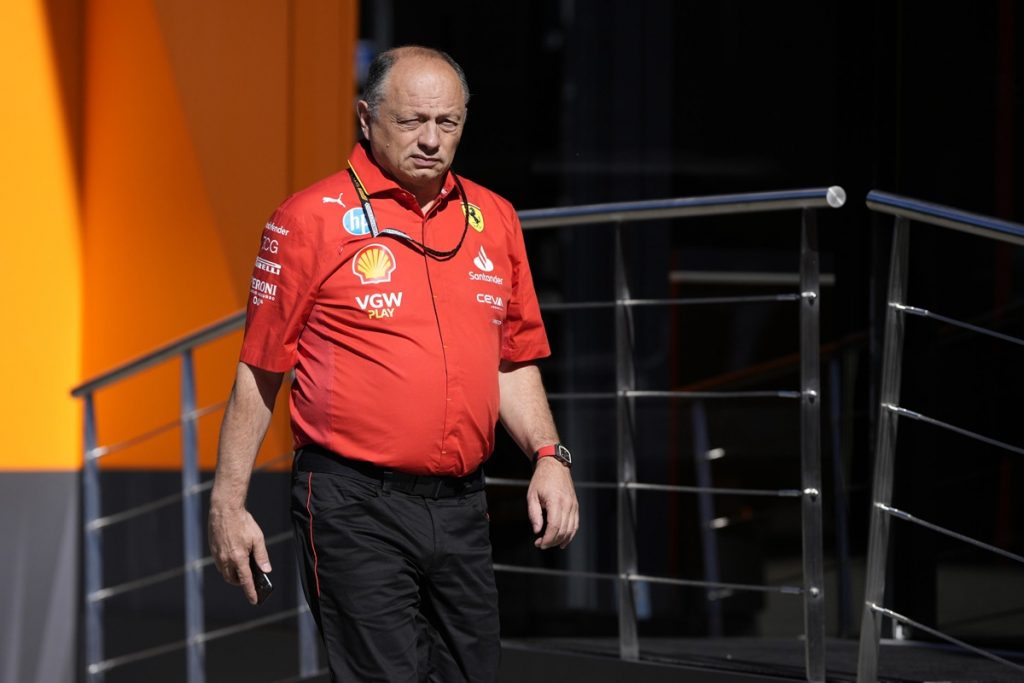
Vasseur admitted that the tyre problems that contributed to both drivers recording extreme fluctuations in lap time across the race epitomised the Italian marque’s weekend.
“Yeah, it’s a good summary of the weekend,” Vasseur laughed.
“I don’t want to speak in details of technical stuff. But for sure it’s a lot about tyre temperature, and in certain phases of the race or certain conditions we are struggling more.
“And yeah, there was a huge gap between the beginning of the stint of Charles on softs and last couple of laps, when he was almost as fast as the guys with new tyres.”
Vasseur highlighted how the sensitivity of the tyres, particularly in low ambient temperatures, can nullify any competitive strides that a team has made through upgrades.
“As usual, when you have an issue with tyres, the effect or the impact is always much, much higher than the characteristic of the car, or the upgrade that you bring,” he explained.
“You can bring an upgrade a weekend, if you are not in the right spot with the tyres, you are nowhere because the magnitude of this is half a second, but most of the upgrades or the characteristic of the track is tenths.
“This weekend I think we were able to be into the pace on some occasions, and [on] some occasions we were far away.”
Vasseur also pinpointed that the straight-line speed deficit that has plagued Ferrari throughout 2026 compounded the complications already plaguing the squad in Brazil.
“Then there is another issue – starting from the back with the penalty, and the fact that we are still struggling in terms of top speed,” the Frenchman added. “When you have only one line dry, it’s mega difficult, and we are stuck at the back.”
He concluded: “Friday we struggled. Saturday was much better, both conditions [dry FP3 and wet qualifying], but I think it’s an accumulation between the mix of the top speed issue, we had to put the tyres in temperature, and we are at the back, and we are struggling. And then we are trying to find a shortcut on the strategy, and so on.”