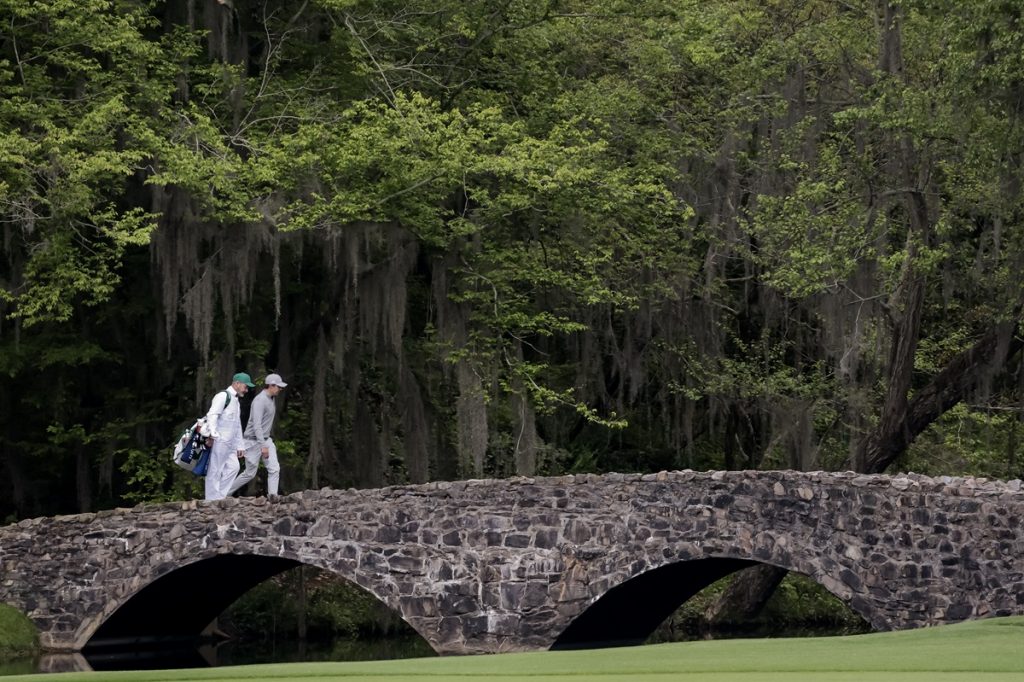
Every major has their defining characteristic. Augusta is the traditional one that makes you feel like you have entered a time machine. The US Open is the cruel one, where the USGA lets out all their most sadistic impulses on the most difficult setups available.

The Open is the annual celebration of links golf (which is in its own way like a time machine). Players need to come to terms with rugged terrain and exposed conditions, as if they have waltzed into a forgotten chapter of Wuthering Heights. For a long time, the PGA Championship suffered with an identity crisis. The year’s least celebrated major just doesn’t have that one defining characteristic that sets it apart. It offers spots to all recent PGA Tour winners and, unlike the other majors, only focuses on professionals (no amateurs invited). So, strictly speaking, it is probably the major with the most competitive field. Still, it didn’t exactly stick, did it?
A change in schedule made all the difference
The biggest problem that this tournament had was a scheduling one. The PGA Championship used to have the unenviable task of being the season’s major curtain-call, coming after the great transatlantic exodus to the Open Championship. It just always felt anticlimactic after all that. Known colloquially back then as ‘glory’s last shot’, many of the top professionals were absolutely shattered by the time the PGA Championship rolled into town. That is probably one of the reasons that there used to be so many surprise PGA Championship winners (Toms, Been and Micheel won in successive years from 2001-2003). In 2019, the PGA of America wisely opted to move the event to May, condensing the major calendar while letting the Open take its rightful place as the season’s final major. It has successfully rebranded itself in recent years, positioning itself as the more approachable version of the US Open (the setups don’t feel like something designed by the Devil on Sims). And it has enjoyed a real resurgence of late, with marquee names fighting it out for the chance to lift the prestigious- and massive- Wannamaker Trophy.
The rise of professionalism
To understand the origins of this event, one needs to imagine a time where professionals were essentially persona non grata. The history of professional golf in America can be traced back to the formation of the USGA (the same group of sadists who set up those US Open monstrosities). In 1894, two unofficial national championships for amateurs were created. One was held at Newport Country Club, Rhode Island, while the other took place at Saint Andrew’s Golf Club in New York. The Saint Andrew’s Golf Club decided to host a simultaneous championship for the pros (which was controversial in a time when professionals golfers were sneered at). All these moving parts necessitated stronger organization, leading to the formation of the United States Golf Association (USGA), the first formal golf organization in the country. The formation of the USGA led to a huge spike in the popularity of the sport, paving the way for the professional era.
The PGA of America is born
But 1916 marked the true birth of professional golf in America. Wealthy department store owner Rodney Wanamaker was a key figure in this event’s inception (he didn’t just lend his name to that somewhat ridiculous trophy). Seeing the business potential in professional golf, Wanamaker and his cohorts organized a luncheon in New York City, establishing a national body to represent and serve the interests of the growing contingent of professional players. The PGA of America was officially formed with 35 original charter members. To commemorate this, the first PGA Championship was played in 1916, with Jim Barnes winning 1-up against Jock Hutchison at Siwanoy Country Club. This year marks the 108th renewal of this event.
The Course
This year’s 2nd major will take place at celebrated Pennsylvanian classic Aronimink Golf Club. Aronimink does have some major pedigree, with Gary Plyer claiming victory at the 1962 edition (it says something about his longevity that he’s still going strong). Designed by famed golf architect Donald Ross, Aronimink changed in character over the years. This led to a comprehensive restoration by Gil Hanse and Jim Wagner, who looked to return it to something resembling its original design ahead of the 2018 BMW Championship. It is certainly not the type of bomber’s paradise that we are accustomed to in American major championships. It is a par-70 that can be stretched to around 7, 267 yards at the tips. Players will need to negotiate several doglegs and strategically placed hazards (there are 75 potentially ruinous bunkers out there). The greens are vast and undulating, meaning players will need their iron-play to be sharp to access certain pins.
Tough enough for a major?
Aronimink has been the subject of some intense media scrutiny, with some believing that it a bit rudimentary for the world’s top players. While I see a winning score well into the double digits under par, I still think many of the misgivings are unfounded. The spring weather in Pennsylvania is cool, and the course is likely to play much further than advertised. Also, my understanding is that they have set the course up firm and fast, with juicy rough for anyone who strays too far from the beaten path. Look for players who have strong, accurate tee-to-green games. They should be able to avoid the big numbers while finding the correct quadrants of the greens with their irons. The greens are going to be firm and fast and will probably be something of a leveller.
Key narratives
World No.1 Scottie Scheffler will be looking to make it back-to-back titles after his dramatic victory at Quail Hollow last year. He was unerring under pressure last season, withstanding a late Rahm surge to win by five strokes. Victory at Quail Hollow truly underlined Scheffler’s current dominance of the sport. The tee-to-green demon hasn’t won since the American Express but has finished solo 2nd in his last three outings (including Augusta). His accurate, repeatable driving make him an amazing candidate for success at Aronimink. Rory McIlroy is a bit of a different beast. The Northern Irishman perhaps revelled in his recent Masters victory a bit too much and looked undercooked at Quail Hollow. I just get the feeling that he hasn’t played quite enough competitive golf of late (even if he did finish solo 5th here at the 2018 BMW Championship). Elsewhere, Cam Young and Matthew Fitzpatrick have worked to close the gap on Scheffler and McIlroy. Young and Fitzy have both been playing incredible golf and both look well suited to this course.
Sidenote: Jordan Spieth hasn’t really been a factor in the majors for some time now. So much so, that it’s easy to forget that he could complete the career Grand Slam in Pennsylvania. I wouldn’t be overly surprised if we saw a slight Spieth surge. There will be slightly less of an emphasis on massive driving this week and Spieth’s mastery of complicated green complexes could come to the fore.
Betting Favourites (To Win): Scottie Scheffler (3.8/1), Rory McIlroy (7/1), Bryson DeChambeau (10/1), Cameron Young (12/1), Jon Rahm (14/1)
Past Winners
2025: Scottie Scheffler (-11)
2024: Xander Schauffele (-21)
2023: Brooks Koepka (-9)
2022: Justin Thomas (-5) *playoff
2021: Phil Mickelson (-6)
2020: Colin Morikawa (-13)
Value Bets
Collin Morikawa- To Win (33/1)
Sure, Morikawa didn’t exactly light it up at Quail Hollow. But he has been in excellent form otherwise, bringing form figures of 1-T7-5-T7-T4-T62 to Aronimink. He has reestablished himself as one of the game’s elite ball strikers, gaining almost ten shots on approach in his victory at Pebble Beach. He seems so much more comfortable since reverting back to that baby fade of his. With its relatively short length and emphasis on strong iron play, Aronimink seems ideally suited to Morikawa’s abilities.
Justin Rose- To Win (40/1)
The 45-year-old Augusta ‘nearly-man’ is obviously running out of chances to add to his lone major title. However, he did win his only major in this state, claiming the 2013 US Open at Merion Golf Club. He also has some excellent form on this course, claiming the old AT&T Championship back in 2010. He decimated the field at Torrey Pines earlier this year before bottling it on the back-9 at Augusta. He has flattered to deceive in his last two outings, struggling a bit with those new McClaren irons. Still, his course history could give him a bit of an edge
Russell Henley- To Win (50/1)
Russell Henley hasn’t quite been the force that he was towards the latter part of last season. Still, the accurate American has managed three top ten finishes this season thus far, highlighted by a brilliant T3 finish at Augusta. Henley’s accuracy-based game has come to the fore in recent major championships, with the Georgian picking up five top ten finishes in his last seven major championships. He is currently ranked 1st on the tour for both Driving Accuracy and Scrambling- a potentially vicious combination on this layout. Henley should avoid much of the trouble and can lean on that amazing recovery play should he find the juicy rough.
The Man to Beat- Cameron Young- To Win (12/1)
I backed him at Augusta, and I simply must back him again. Quite simply, it’s hard to spot any weaknesses in Young’s game right now (and Scheffler’s presence in the market helps keep everyone else at a respectable number). He buffered a bit in contention at Quail Hollow, but it’s important to remember that many of the players already have one eye firmly fixed on Aronimink. Youngs’s recent form makes or astonishing reading, as he brings form figures of T7-T3-1-T3-T25-1-T10 to Pennsylvania. He is hitting the ball purely, giving himself plenty of looks with his surgical iron play. It’s surely just a matter of time till he claims his maiden major title.