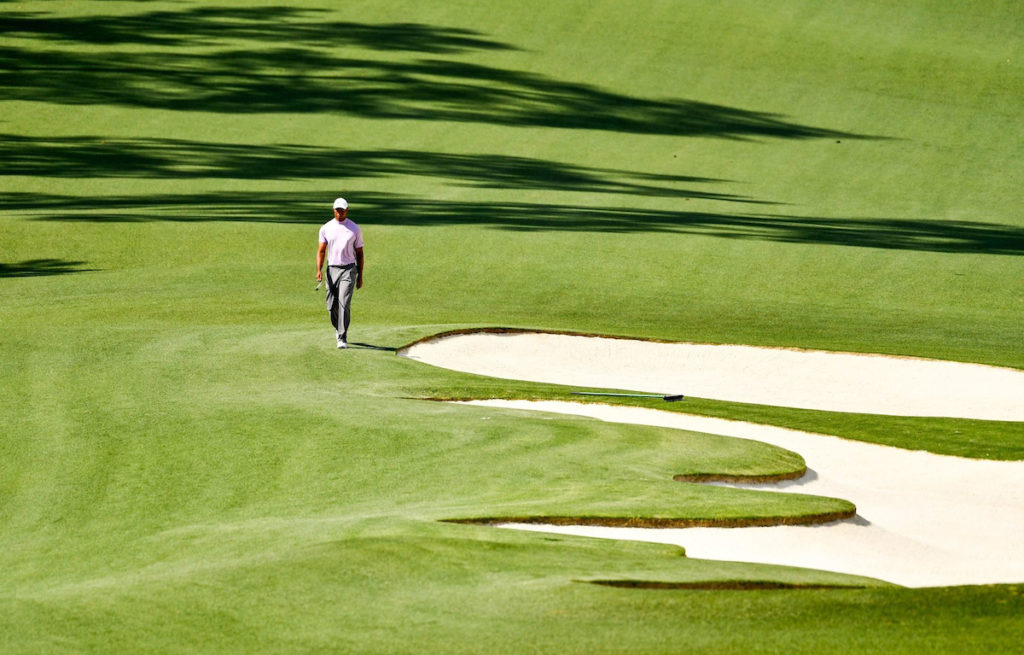
Much like last year’s host venue Oakmont, Shinnecock is notoriously difficult and will stretch players to their mental breaking point. For my final little pre-tournament assessment, I have decided to focus on the five holes that could play a huge role in deciding this week’s champion. Look, Shinnecock is a multi-faceted tyrant that can hurt you at any turn (no specific holes are going to prove decisive in and of themselves). I just think that playing these five holes well will put you in an excellent position come Sunday afternoon.
No.2- ‘Plateau’- Par 3 (252 yards)
The first hole, ‘Westward Ho’, is like a lovely Beatles number that everyone can dance along to. The par 3 2nd is a full-on heavy-metal number that will evacuate the dance floor. Depending on how they set it up, Plateau can play as long as 260 yards. The longest par 3 on the course takes players firmly out of their comfort zone before they have got to grips with conditions. The tee shot will require anything from a 5-iron to a fairway wood, as players look to attack this severely uphill green (drivers have been known to come out in the face of stiff headwinds). The green features a false front and extensive runoff areas that feed into expectant bunkers. In many ways, this hole encapsulates the entire Shinnecock experience: intimidating and uninviting. Negotiating this first real test could give players the impetus to have a positive round.
No.5- ‘Montauk’- Par 5 (592 yards)
Traditionally the easiest hole on the course, players need to exploit this reachable par 5 if they wish to balance their scorecards. The players are faced with a double fairway from the tee; a more aggressive option on the left, and a more conservative, ‘three-shot’ option on the right. Montauk typically has the prevailing wind in from behind during the summer, meaning that many of the players are likely going to be bombing it down the left to take a shot at reaching this bad boy in two. There is certainly some peril out there, with one of the most elevated greens on the entire course. Most long approaches will be tossed off this green complex, putting a huge onus on player’s abilities to get up and down. Players need to capitalize on this relatively scorable opportunity.
No. 10- ‘Eastward Ho’- Par 4 (415 yards)
It’s strange to see a reasonably short par 4 regularly rank as one of the toughest on a US Open course (Eastward Ho was ranked the toughest hole during the 2004 US Open before ranking 4th toughest during the 2018 renewal). This is a true risk-reward masterclass, leaving players with a telling decision off the tee. They can hit a long iron to a plateau and leave themselves with around 150 yards. Or they could bomb driver and risk hitting the ball into one of the many bunkers gathered in a hollow leading into the green complex (where they will also have to negotiate a tough uphill pitch). Either way, players are required to hit their tee-shot over a ridge and into a blind landing area (this is where strong caddies could come to the fore). The elevated green has a massive false front that will reject golf balls like a grouchy bouncer during Spring break. The green tilts dramatically from back-right to front-left and there is a deep, closely mown collection area through the back. Players will need to judge the wind perfectly if they wish to survive this examination.
No.11- ‘Hill Head’- Par 3 (157 yards)
Lee Trevino said it best when he described Hill Head as ‘the shortest par 5 in golf’. While the par 3 7th ‘Redan’ is considered the signature hole, this little gem just feels more dramatic. Often described as the best uphill par-3 in world golf, Hill Head plays roughly 50 feet uphill to a semi-blind, tabletop green. Players will have just a wedge or short iron in hand, but the safe zone is tiny. Koepka hit his tee shot through the green here during the final round of his 2018 championship-winning campaign. He followed that up with a bold decision, intentionally hitting his pitch into the front bunker as opposed to taking on the flag directly. He got up and down for one of the greatest bogeys you are likely to see. This card-wrecker needs to be negotiated strategically, minimizing any damage heading into the final stretch.
No.18- ‘Home’- Par 4 (490 yards)
This humungous closer could be a heartbreaker. Corey Pavin famously approached with a 4-wood back when he won the tournament in 1995. While the modern players may have considerably less in their hands, there is still plenty to take into consideration on this hole. A blind tee shot requires precision to leave the ideal angle to attack a green guarded by bunkers. But the green complex is one of Shinnecock’s most fiendish torture chambers. The green- which features swallows and rises that can alter the fabric of a round- looks epic against the backdrop of the stunning Stanford White-designed clubhouse. Players better pray they aren’t left above the hole with a little four-footer to either make the cut or win the US Open.