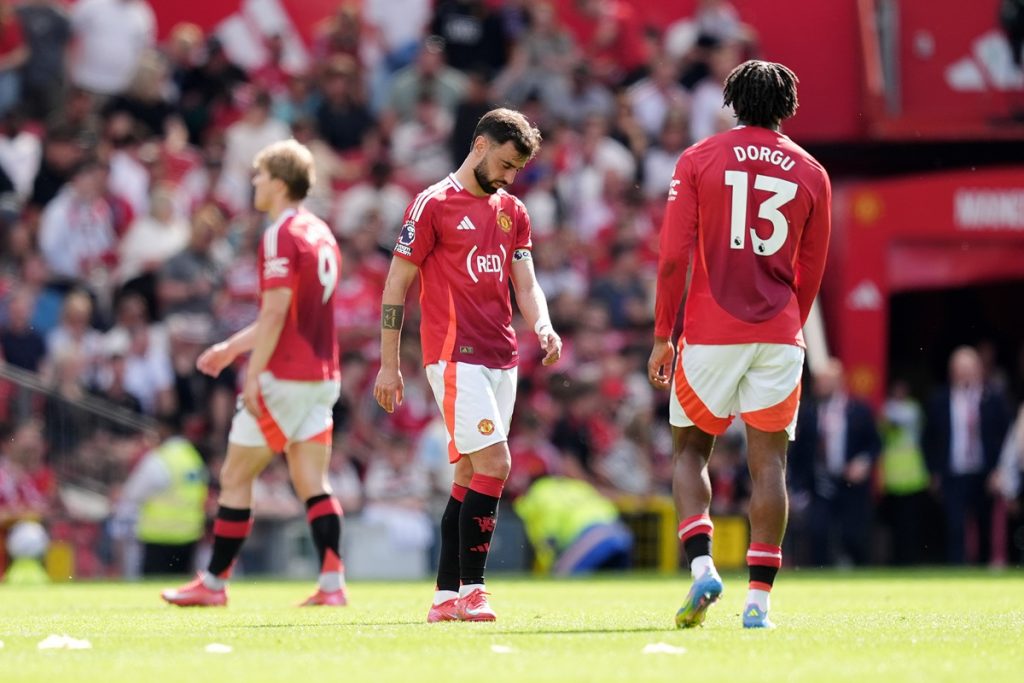
Yet despite the dropped points, I think United fans have a reason to be excited. Carrick’s side tapped into Fergie-based nostalgia, equalizing in the 96th minute to continue their recent habit of salvaging last-gasp points. Sir Alex Ferguson’s all-conquering United sides of the 90’s and 00’s were renowned for their ability to pinch last-minute goals, creating a mystique that would define the Premier League era. I just want to quickly pinpoint some key instances of Fergie Time and how Carrick appears to have renewed that energy.
A brief history of (Fergie) time
I think that most onlookers will trace the genesis of Fergie Time to that famous 1993 league victory over Sheffield Wednesday, where Steve Bruce scored deep into stoppage time to help secure Ferguson’s first title win. I personally will never forget Brian Kidd collapsing to the ground with the theatricality of 90’s Michael Jackson. That moment took hold in our collective psyche, paving the way for the term ‘Fergie Time’ to enter the footballing lexicon. The term had both positive and negative connotations, pointing towards United’s never-say-die attitude and a perceived bias towards the Mancunian giants.
Scoring late in key moments
Statistical analysis suggests that the entire Fergie Time phenomenon was a bit overstated. However, they did have a way of digging themselves out of trouble in crucial situations. The 1999 Champions League final was an iconic example of United snatching a game at the death, with Teddy Sheringham and Ole Gunnar Solksajer completing an incredible late comeback against a vastly superior Bayern Munich side. Then you had the most indelible instance of Fergie Time in the 21st century, where City boss Mark Hughes was left seething after Michael Owen’s incredibly late derby-day winner (that one felt a little off the books). It makes sense that United- a perennial title contender during that period- would nick plenty of results in the final moments of the game. They had incredible attacking resources at their disposal and were often on the front foot.
The psychological dimension
I think the one thing that is overlooked in relation to this topic is the psychological dimension. Teams- and by extension fans- feared prime-United’s resolve. And Michael Carrick appears intent on recapturing that fear factor. Carrick has made several commonsense tactical changes since Amorim’s departure, reverting to a more traditional 4-4-2 while reincorporating Koobie Mainoo into the heart of midfield. He has freed Fernandes to play in his preferred no.10 role (not exactly a tactical masterstroke ). But he has also shown a more adventurous spirit than some of his predecessors, desperately committing men forward at all costs. And the players- and fans- are clearly responding to that sense of desperation.
Just look at their last-gasp heroics at the London Stadium. Carrick rolled the dice, taking Dalot off and throwing on Zirkzee to support Sesko. He reverted to a back three, instructing all the other players to bomb forward. West Ham had a few chances to bury the game but failed, allowing United to pounce with an expertly taken goal by Sesko at the death. That is the type of calculated gamble that was commonplace in Fergie’s era. Most United fans will accept the occasional glorious defeat if it means United are playing with an attacking ethos.
A growing trend
And Tuesday night was no isolated incident (though five games is a small sample size). United have scored in the final 14 minutes in all five of their games under Carrick. They have scored three times in the 87th minute or later, earning five points from those strikes. This is the clearest indication- outside of the formation change- that Carrick is drawing inspiration from his old boss. He has even turned Sesko into Solskjaer 2.0, using him sparingly while extracting two stoppage-time goals. I’m pretty sure that the Slovenian doesn’t envisage himself as some glorified super-sub. But if the boot fits.
Reclaiming their identity
Carrick seems to be turning United into something that they haven’t felt like in some time: a big club. And big clubs, when they need a goal, tend to press the issue in the later stages of a game. It’s not rocket science. It’s quite impressive that Carrick has been able to recapture that joie de vivre in such a short period. It marks a complete attitudinal shift that augers well for their chances of Champions League qualification. Now if only they can win five straight games and allow that one poor guy to cut his hair (I’m sure his family would be so relieved).